
When an industrial buyer requests “a machined part,” it is not always clear which machining process they actually need. Milling, turning and grinding are not synonyms: each one produces different geometries, achieves different tolerances and carries different costs. Understanding these differences allows you to specify your part correctly, evaluate supplier proposals and avoid surprises in price or lead time.
What is industrial machining?
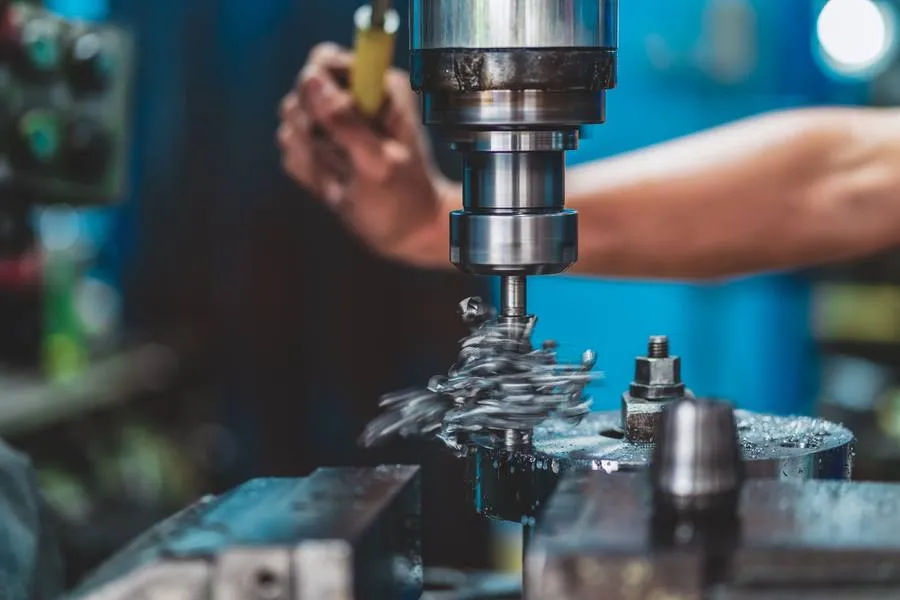 Industrial milling operation at TILCA’s facilities
Industrial machining covers subtractive manufacturing processes: starting from a piece of stock material (bar, block, plate, casting), material is removed with cutting tools until the geometry and dimensions specified in the technical drawing are achieved.
Conventional vs. CNC machining
Conventional machining depends on the operator to control the machine’s movements. CNC machining automates that control through a computer program, achieving higher precision, repeatability and production speed. Today, almost all industrial precision machining is done on CNC machines.
Materials that can be machined
Practically all metals are machinable: carbon and alloy steels (4140, 4340), stainless steels, aluminum, bronze, brass, titanium, cast iron. Engineering plastics (nylon, HDPE, UHMW) are also machined for specific applications.
Types of industrial machining processes
CNC turning: shafts, axles and cylindrical parts
In turning, the part rotates on its axis while the cutting tool advances linearly. It produces geometries of revolution: cylinders, cones, spheres, external and internal threads, grooves, stepped profiles. It is the process for shafts, axles, bushings, pulleys, pinions, rollers, power screws and any part whose profile is symmetrical about an axis of rotation.
Modern CNC lathes include live tooling that allows milling, drilling and threading in the same setup, producing complex parts in a single clamping.
CNC milling: flat surfaces, slots and complex geometries
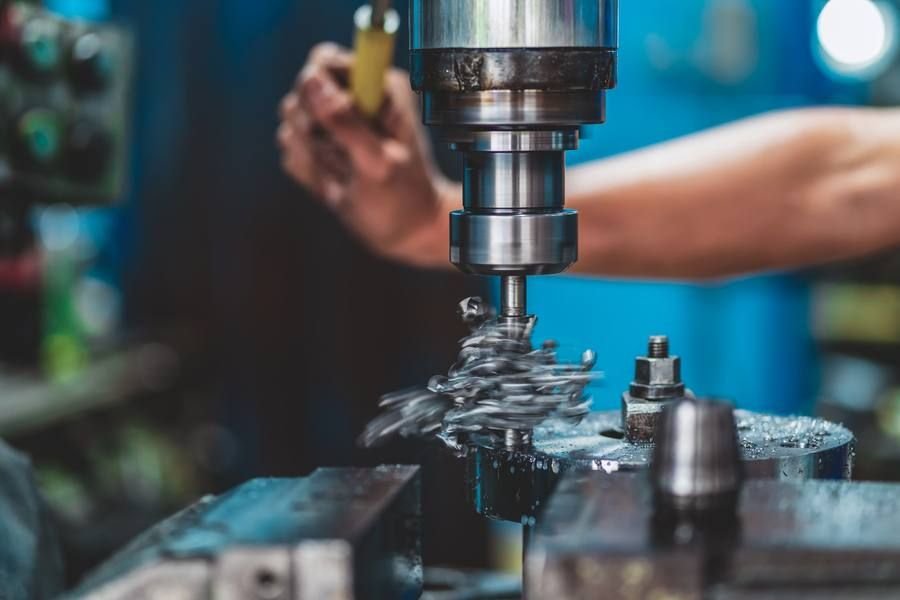
In milling, the rotating tool (mill cutter) travels across the fixed part along programmed paths in X, Y and Z. It produces flat surfaces, slots, pockets, contours, gear profiles, sculpted surfaces and any geometry that is not a simple body of revolution. It is the process for blocks, flanges, covers, plates, housings, gears and prismatic parts.
Five-axis machining centers can machine complex geometries in a single setup, including inclined surfaces, undercuts and features on multiple faces.
CNC grinding: high-precision dimensional finishing
Grinding uses an abrasive wheel to remove small amounts of material (< 0.1 mm) from an already-machined part. The goal is to achieve very tight dimensional tolerances (±0.002 mm) and fine surface roughness (Ra 0.4–0.8 µm) that conventional cutting tools cannot reach.
It is used on parts that require a precise fit with other components: precision pins, bearing seats, linear guides, crankshafts and sealing surfaces. It is generally the last process in a machining chain.
Tolerances and surface finishes in precision machining
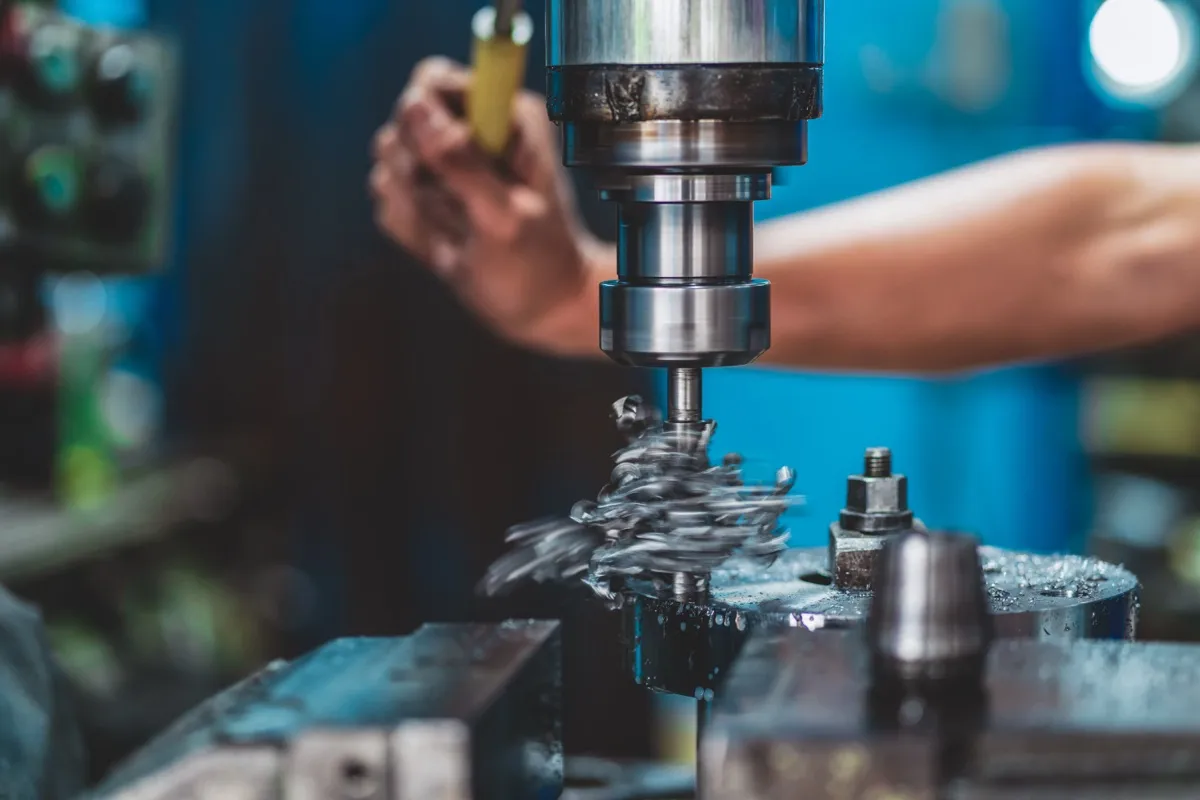 High-precision CNC milling on a steel part
ISO tolerance classification
| Process | Typical tolerance | Typical Ra roughness |
|---|---|---|
| Rough turning | ±0.1–0.3 mm | 6.3–12.5 µm |
| CNC finish turning | ±0.025 mm | 1.6–3.2 µm |
| Rough milling | ±0.1–0.2 mm | 3.2–12.5 µm |
| CNC finish milling | ±0.020 mm | 0.8–1.6 µm |
| Machining center | ±0.010 mm | 0.8–1.6 µm |
| Cylindrical grinding | ±0.002–0.005 mm | 0.2–0.8 µm |
| Surface grinding | ±0.005 mm | 0.4–0.8 µm |
Ra surface roughness and its importance in assemblies
Ra roughness measures surface texture at a microscopic scale. A surface with high Ra (rough) may be perfectly valid for a structural part but unacceptable for a bearing seat or a sealing surface. Always include the Ra specification on your drawing where relevant.
Industries that rely on industrial machining in Mexico
Sugar industry: rollers, conveyors and crusher parts
Sugar mills are among the most intensive users of industrial machining in Mexico. Mill rollers, crusher shafts, pinions and conveyor drive shafts require precision machining in materials such as 4140 steel, bronze and stainless steel. TILCA’s geographic proximity (Córdoba, Veracruz) to the sugarcane region of Veracruz, Oaxaca and Puebla is a significant logistical advantage.
Petrochemical, automotive and general manufacturing
The petrochemical industry orders high-strength parts in alloy and stainless steels. Automotive requires production runs with ISO H6/h6 tolerances. General manufacturing and agro-industry are the broadest market: from emergency spare parts to components for new equipment.
What should a good industrial machining shop have?
Machine capacity and equipment
- CNC lathes with sufficient swing and length capacity for your parts.
- Milling machines or machining centers with at least 3 axes.
- Grinders (cylindrical and surface) for high-precision parts.
- Measuring equipment: micrometers, dial indicators, roughness testers, CMM.
Quality control and traceability
A serious shop must be able to document the critical dimensions of every part delivered. Request dimensional inspection reports when your part’s tolerances are tight (< ±0.05 mm) or when the part is for a safety application.
Checklist for requesting a machining quote
- Technical drawing in PDF or DXF with all dimensions and tolerances.
- Material specification (AISI/SAE grade, standard, hardness if applicable).
- Required surface roughness (Ra in µm) on critical surfaces.
- Quantity (single part, short run, medium run).
- Required delivery date.
- Heat treatment or coating needed after machining.
- Applicable quality standard (ASME, AWS, customer’s internal standard).
Tip: if you don’t have a technical drawing but do have the worn physical part, TILCA can perform direct dimensional measurement and manufacture the replica. This service is very common for obsolete spare parts of imported equipment.
Frequently asked questions about industrial machining
What is industrial machining?
Manufacturing processes in which material is removed from a workpiece with cutting tools to achieve the specified geometry and dimensions. The main ones are turning, milling, grinding, drilling and threading.
What tolerances can industrial machining achieve?
Standard CNC: ±0.025 mm. High-precision machining centers: ±0.010 mm. Grinding: ±0.002 mm.
How long does it take to manufacture a machined part?
Simple part: 3–7 business days. Complex parts or parts requiring heat treatment: 7–20 business days. For urgent requirements, check availability directly.