
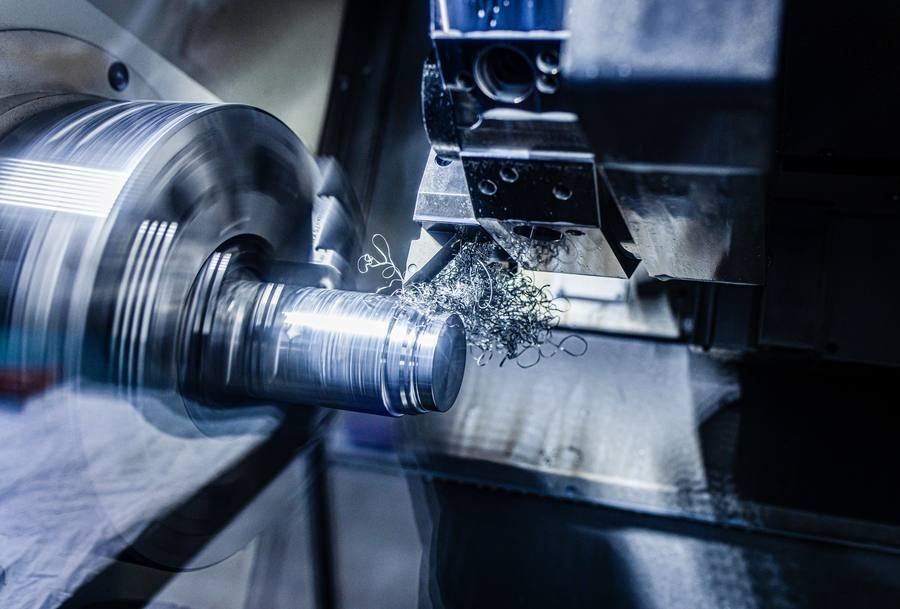
CNC machining (Computer Numerical Control) is today’s precision standard in industrial manufacturing. From producing gears for the sugar industry to critical components for petrochemicals, CNC machining makes it possible to manufacture parts with tolerances of hundredths of a millimeter, repeatably and efficiently. In this article we explain what it is, how it works and when it is worth integrating this technology into your industrial projects.
What is CNC machining?
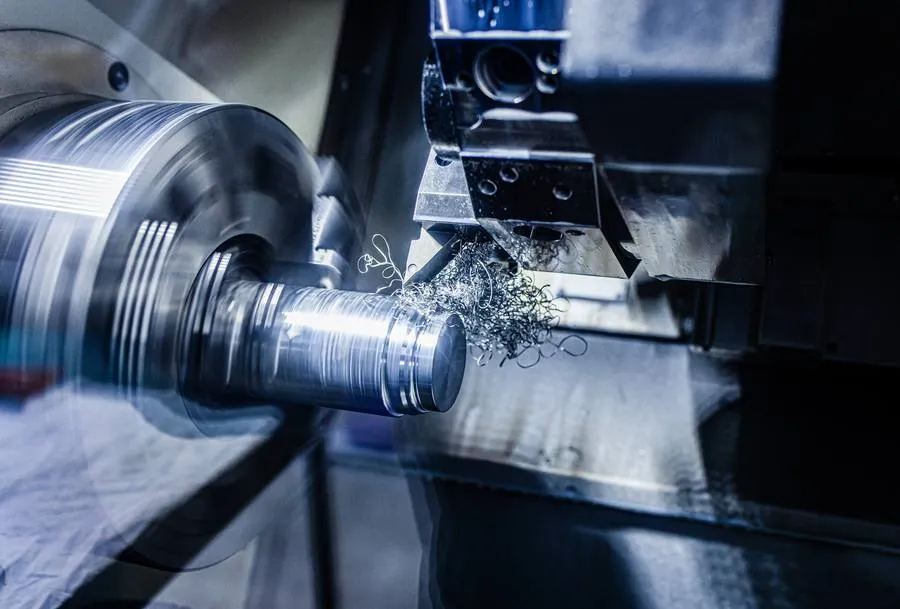 High-precision CNC lathe at TILCA’s facilities in Veracruz
CNC stands for Computer Numerical Control. It is a system in which the movement of a machine tool — lathe, milling machine, machining center — is fully controlled by a computer program instead of depending on the operator’s manual adjustments.
The program, called G-code, specifies movement coordinates, cutting speeds, feed rates and operation sequences. The machine reads that code and executes each instruction with micrometric precision.
The difference between CNC and conventional machining
Conventional machining depends on the operator’s skill to adjust tools, feeds and depths of cut. The result varies from part to part and from operator to operator.
CNC machining eliminates that variability: once the part is programmed, the system reproduces exactly the same movements in every cycle. This is essential when manufacturing production runs or when dimensional specifications are critical.
How does the CNC machining process work?
From CAD/CAM design to G-code
The CNC workflow starts with the part design in CAD (Computer-Aided Design) software. Once the geometry is defined, the manufacturing engineer uses CAM (Computer-Aided Manufacturing) software to define tool paths, cutting speeds and machining strategies. The CAM system automatically generates the G-code, which is loaded into the machine’s control.
Machine types: CNC lathe, CNC mill, machining center
- CNC lathe: rotates the part on its axis while the cutting tool advances. Ideal for cylindrical geometries: shafts, axles, bushings, pulleys, pinions.
- CNC milling machine: the rotating tool travels across the fixed part along X-Y-Z coordinates. Produces flat surfaces, slots, pockets, complex surfaces and contours.
- CNC machining center: combines multiple operations (milling, drilling, tapping) in a single setup. Minimizes re-clamping errors and reduces process times.
- CNC grinder: uses an abrasive wheel to achieve fine surface finishes and dimensional tolerances of ±0.002 mm on already-machined parts.
Tolerances and precision: what to expect from industrial CNC machining
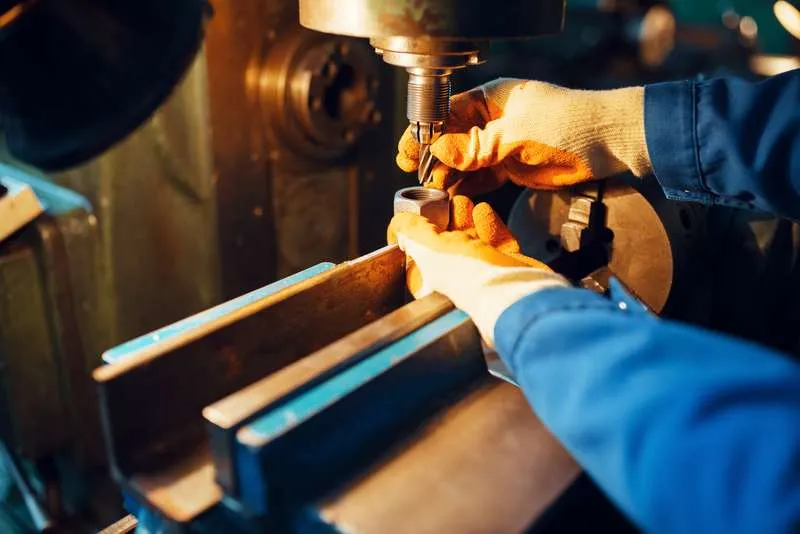 Tolerance control on CNC-machined parts
Typical tolerances on industrial parts
Tolerance is the acceptable margin of dimensional variation from the nominal dimension. In standard industrial CNC machining:
| Machine type | Typical tolerance | Common applications |
|---|---|---|
| Conventional CNC lathe | ±0.025 mm | Shafts, bushings, pulleys |
| CNC milling machine | ±0.020 mm | Pockets, profiles, flanges |
| Machining center | ±0.010 mm | High-precision parts |
| CNC grinder | ±0.002 mm | Crankshafts, pins, guides |
Surface finishes and technical specifications
Beyond dimensional tolerance, CNC machining allows you to specify surface roughness (Ra), which determines how smooth or rough the surface will be. An Ra of 1.6 µm is adequate for sliding parts; Ra 0.4 µm for sealing or fitting surfaces.
Key for your quote: when requesting CNC machining, always include a technical drawing with tolerances, required surface finish and specified material. This eliminates ambiguity and allows you to receive an accurate quote.
Materials that can be CNC machined
Carbon and alloy steels
Steels are the most common material in industrial machining. 4140 steel is the workhorse of the industry: good machinability, high strength and hardenable for impact applications. 4340 steel is reserved for more demanding parts (see the full comparison in our steel article). Stainless steels 304 and 316 are used in corrosive or food-contact environments.
Aluminum, bronze and non-ferrous metals
Aluminum (6061, 7075 alloys) is easy to machine and stands out for its light weight. Bronze (Cu-Sn alloys) is machined into bushings, bearings and pillow blocks where wear and corrosion resistance are required. Learn more about the properties of these materials in our article on bronze vs aluminum casting.
Industries that benefit from CNC machining in Mexico
Sugar industry: rollers, bearings and shafts
Sugar mills require high-precision parts capable of withstanding extreme loads, humidity and exposure to corrosive products. Mill rollers, crusher shafts and bronze bearings demand tight tolerances and specific materials. TILCA, based in Córdoba, Veracruz, sits in the most important sugarcane region of the country.
Petrochemical, automotive and food industries
The petrochemical industry orders valves, flanges and pinions machined in stainless steels or special alloys. Automotive requires repeatable volumes with ISO H6/h6 shaft tolerances. The food industry demands smooth surfaces and materials that meet sanitary standards (316L steel, anodized aluminum).
Why hire CNC machining from a specialized shop in Veracruz?
Advantages of a local vs. distant supplier
A CNC machining shop in Veracruz like TILCA significantly reduces delivery times and freight costs for companies in the region (sugarcane zone, Coatzacoalcos petrochemical hub, Puebla industrial corridor). Direct communication with the engineering team enables quick adjustments and avoids drawing-interpretation errors.
What to check before requesting a CNC machining quote
- Complete technical drawing with dimensions and tolerances (PDF or DXF format preferred).
- Material specification (name, grade, standard: AISI 4140, ASTM A36, etc.).
- Required surface roughness (Ra in µm or finish symbol on the drawing).
- Number of parts, and whether a prototype is required before the production run.
- Necessary heat treatment or coating (quenching, zinc plating, phosphating).
Frequently asked questions about CNC machining
What is CNC machining?
It is a manufacturing process in which machine tools execute movements controlled by a computer program (G-code), making it possible to produce parts with tolerances of ±0.005 mm repeatably.
How much does CNC machining cost in Mexico?
It depends on material, geometry, tolerances and quantity. A simple one-off part can cost from MXN $300; complex parts with tight tolerances can exceed MXN $5,000. Requesting a quote with a technical drawing is the most accurate way to get a real price.
What is the difference between CNC turning and milling?
In turning, the part rotates and the tool advances: it produces cylindrical geometries. In milling, the tool rotates and travels across the part: it produces flat surfaces, slots, profiles and complex geometries. Many industrial parts require both processes; in that case a CNC machining center is used.
Can I order a single part, or do I need to order a production run?
At TILCA we manufacture everything from single parts (prototypes or urgent replacements) to short and medium production runs. CNC programming has an initial setup cost, which is best amortized over production runs, but it is not an obstacle for single-part orders of industrial components.